





From Leipzig to the OR: How REALISTS Is Bringing Next-Generation Spine Simulation to the United States
Some of the most compelling stories in MedTech don’t start in a boardroom. They start with a problem no one is taking seriously enough.
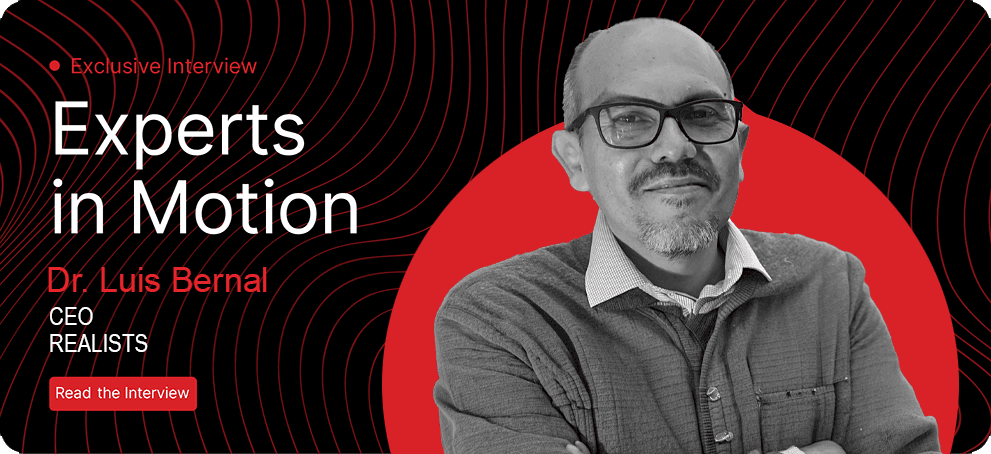
An Interview with Dr. Luis Bernal, CEO of REALISTS Training Technologies
By Guillaume Viallaneix | Editor-in-Chief, The MedTech Digest & President, MedTech Momentum
Some of the most compelling stories in MedTech don’t start in a boardroom. They start with a problem no one is taking seriously enough.
When I first met Dr. Luis Bernal, CEO of REALISTS Training Technologies, what struck me wasn’t the technology itself, although it is genuinely impressive. It was the clarity of his conviction. He believes, to his core, that surgical training has been stuck in the past for too long, and that the tools surgeons use to learn today have not kept pace with the technologies they are expected to master in the OR.
Founded in 2015 as a university spin-off in Germany, REALISTS has spent a decade building a hyper-realistic simulation ecosystem for spine surgery, one designed to standardize, scale, and improve surgical education in ways cadavers simply cannot. With a presence in more than 50 countries and partnerships with major spine OEMs, including Stryker, Medtronic, and DePuy Synthes, the company has now made its most significant move: a full U.S. market launch, with REALISTS USA, Inc. officially established and a VP of Sales on the ground.
“High technology has to be trained with high technology simulation. That’s the core idea behind everything we build.”
A Journey Between Two Worlds
Guillaume Viallaneix: Luis, you grew up in Peru, built your career in Germany, and now you’re bringing a German-engineered platform to the U.S. That’s quite a journey. Who is Luis Bernal?
Dr. Luis Bernal: I grew up in Chiclayo, in northern Peru, very different from Leipzig, where I’ve spent most of my adult life. I wanted to be a doctor. My father was an entrepreneur, so that instinct was in my blood. But I loved numbers, so I chose industrial engineering. I didn’t know then that my career would eventually combine both.
After my MBA in Germany, which I completed entirely in German after learning the language, I worked helping universities transfer research innovations to the market. One of those projects was a two-year government-funded R&D initiative building realistic surgical training models. At the end of those two years, we had something that had never existed before in that form. Two of us founded the company. REALISTS was born in 2015 with seed funding from the German government, and customers already in hand.
The Problem Nobody Talks About Loudly Enough
GV: In simple terms, what is broken about surgical training today?
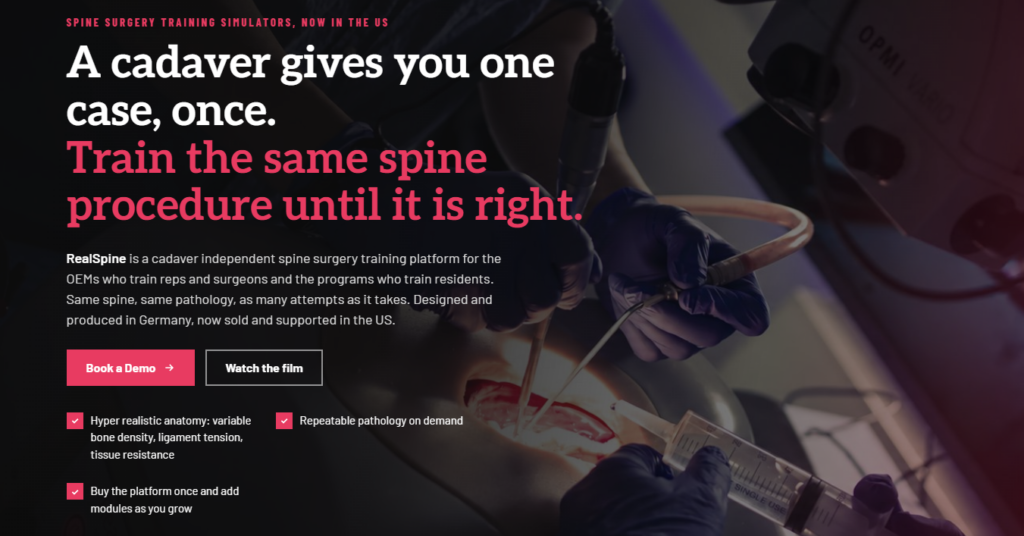
LB: Spine surgery is one of the most common specialties in the world, and yet the training methods haven’t fundamentally changed in a century. We’re still using cadavers as the gold standard. I’m not against cadaver training; cadavers are important. But they have real limitations nobody talks about loudly enough. You can’t standardize a cadaver. You can’t repeat the scenario. You can’t simulate specific complications. And depending on the country, access is unpredictable and expensive.
The deeper issue: surgical technology has advanced dramatically, with robotics, navigation, and minimally invasive procedures. But the training infrastructure hasn’t kept pace. That’s the gap REALISTS was built to close.
GV: And how do you close it?
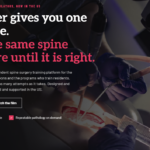
LB: We think of ourselves as a training company, not a simulation company. Our platform combines physical spine models with imaging simulation and performance measurement. The models replicate real patient anatomy and specific pathologies with a level of realism that allows surgeons to practice the gestures, decisions, and corrections they encounter in the OR.
Think of aviation simulators. The best ones don’t just look like a cockpit; they replicate weather, equipment failures, and split-second decisions. That’s what we’re building for spine surgery. Not a product demonstration tool. A real training platform that makes learning measurable and transferable.
“We aren’t just building a simulator. We are building the training environment surgeons actually needed.”
OEM Partnerships and Proof at Scale
GV: REALISTS works with Globus Medical, Stryker, Medtronic, and DePuy Synthes. How have those relationships shaped the company?
LB: They’ve been essential. Surgeons validate every product we launch before it goes to market. The OEM partnerships serve two purposes: during development, our models act as a sandbox where companies test implants in a realistic environment before clearance, shortening cycles and improving the quality of feedback. Post-launch, our platform supports repeatable, scalable surgeon adoption, without the logistical headache of cadaver labs.
One early example, a company developing an implant for disc ruptures, needed to train surgeons across Europe on a very specific pathology. We built a custom model that they could take anywhere. Training became mobile, standardized, and reproducible. That’s the value we create.
The U.S. Launch: Where Leadership Is Established
GV: REALISTS is officially launching in the United States. What does this moment mean for the company?
LB: It’s the decisive next step. Every serious European MedTech company eventually has to ask: when do we go to the U.S.? For us, the timing is right. We have a validated product portfolio, an established international track record, and we’ve spent the past year building the commercial infrastructure, messaging, framework, and now a team on the ground.
Germany is one of the best environments in the world for deep tech innovation. But the U.S. is where you prove that what you’ve built can compete at the highest level. We already have U.S. relationships,
Weill Cornell in New York, Texas Back Institute in Dallas, and they’ve confirmed the problem we solve is just as real here as in Europe. We’re ready for that test.
“The U.S. is where you prove that what you’ve built can compete at the highest level.”
Lessons for Founders
GV: You’ve been building REALISTS for a decade. What would you protect, and what would you do differently?
LB: I’d protect the incubator phase. Using the university environment to validate the product and pricing before we had a legal entity was one of our best decisions. We knew we had customers before we founded the company. That saved significant early-stage risk.
What I’d do differently: invest in revenue generation earlier. Too many founders, including myself, treat sales and marketing as secondary to product development. They’re not. Revenue is how you prove the business model. Revenue is how you attract investors who believe in what you’re building, not just in a pitch deck.
GV: Final question. When you think about the legacy of REALISTS, what do you want people to say?
LB: That we trusted the technology when others were skeptical. We believed simulation could change the gold standard, and then we proved it. But more than that, I hope REALISTS is remembered for what happened at the end of the chain: better surgeons. And better surgeons mean better outcomes for patients. That’s the thread that runs through everything we do.
Luis’ story is one of patience, precision, and purpose. He didn’t rush to market. He didn’t build for the exit. He built for the decade. With a validated international platform and a U.S. commercial footprint now being established, REALISTS is positioned to become the new standard in spine surgery simulation.
To learn more or connect with the REALISTS team, visit realists.de
To schedule a meeting: contact@realists.de
Published in The MedTech Digest — Experts in Motion Series | www.themedtechdigest.com