




Headsafe’s New CEO on Making Objective Concussion Assessment Routine Care
How Craig Corrance plans to bring Nurochek to the frontlines of mild Traumatic Brain Injury care
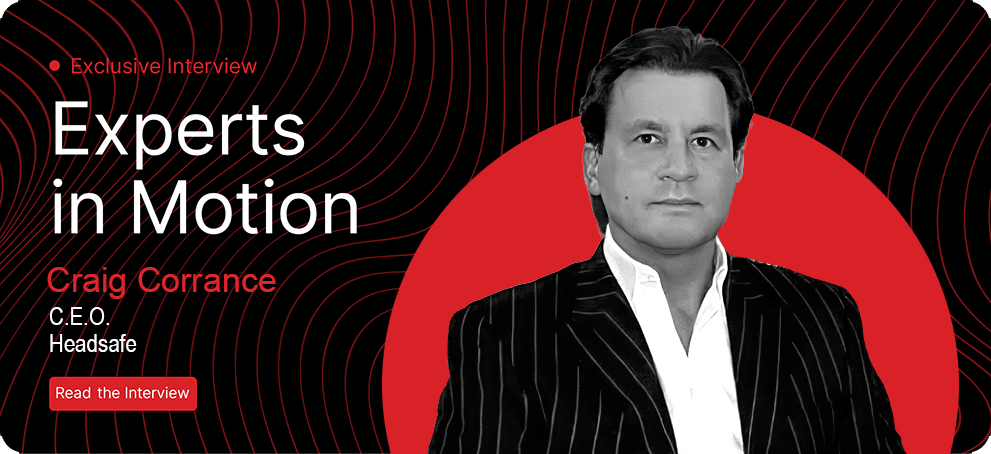
An Interview with Craig Corrance, Headsafe, Chief Executive Officer
By Guillaume Viallaneix | Editor-in-Chief, The MedTech Digest & President, MedTech Momentum

If you are a regular MedTech Digest reader, you may remember our recent Experts in Motion interview with Dr Adrian Cohen, founder of Headsafe and the clinical mind behind Nurochek. He spoke about years on rugby sidelines and in rescue helicopters, where he had to make life-changing decisions about head injuries with limited tools.
Today, we turn the page to the next chapter. Headsafe has appointed Craig Corrance as its new Chief Executive Officer to lead Nurochek’s commercial expansion. Concussion remains a silent epidemic, with millions of injuries every year, of which up to 50% may go undiagnosed. The question now is how to turn Nurochek’s science into routine care in emergency departments, clinics, and sports programs.
This interview is special for another reason. Craig and I have known each other for close to three decades. We have built MedTech businesses together, and he is more than a colleague to me, he is a dear friend. That shared history shapes the conversation you are about to read.
Here Craig speaks directly to Headsafe’s core audiences, from ER physicians to athletic trainers and clinic owners. He explains what his appointment means, how Nurochek works, and why objective brain data belongs in everyday concussion practice.

Guillaume: Craig, first of all, congratulations. What does it mean to you to become CEO of Headsafe?
Craig: Thank you. It is a responsibility I take extremely seriously. Adrian and the team have built something important. My role is to take that mission, which is to make brain injury assessment safer and more objective, and turn it into a scalable business that clinicians can depend on every day.
We are moving from pure innovation to disciplined execution. The technology is proven. Now we focus on adoption, service, and evidence that fits real-world healthcare.
GV: Many readers will have already read Adrian’s interview. How do you see your work fitting with his?
CC: Adrian is the origin story. His experience in emergency medicine and sports gave him the insight that led to Nurochek. He continues to guide our clinical strategy and research.
I come in with three decades of MedTech leadership. I have helped build and exit companies in spine and orthopaedics. I bring experience with strategy, capital, commercialization, and the realities of global distribution. Together, we want to make sure that the science reaches the bedside, the clinic room, and the sideline.
From a Scottish village to neurotechnology
GV: Let us talk about your own journey for a moment. How did it begin?
CC: I grew up in a small fishing village on the east coast of Scotland. My father was a coal miner. People worked hard and looked out for each other. That culture gave me a strong sense of team and responsibility.
Football, or should I say soccer, was my first path. I had an apprenticeship at Sheffield United. That experience gave me discipline, but it also gave me several knee surgeries. Being a patient made me curious about the devices and implants that help people stay active. That curiosity pulled me straight into MedTech.
Over the years at companies like Corin, Scient’x, Altiva, Applied Spine Technologies, and New Era Orthopaedics, you and I spent countless hours in operating rooms, listening to surgeons and turning their needs into practical tools, education, and support. The common thread was always the same: take complex technology, make it simple and reliable for clinicians, and keep engineers, clinicians, regulators, and investors aligned around that goal. Those shared experiences are exactly what we are now bringing to Headsafe as we work to make Nurochek part of routine concussion care.
What Nurochek actually is
GV: For the ER doctor, athletic trainer, or clinic owner reading this, what exactly is Nurochek by Headsafe?
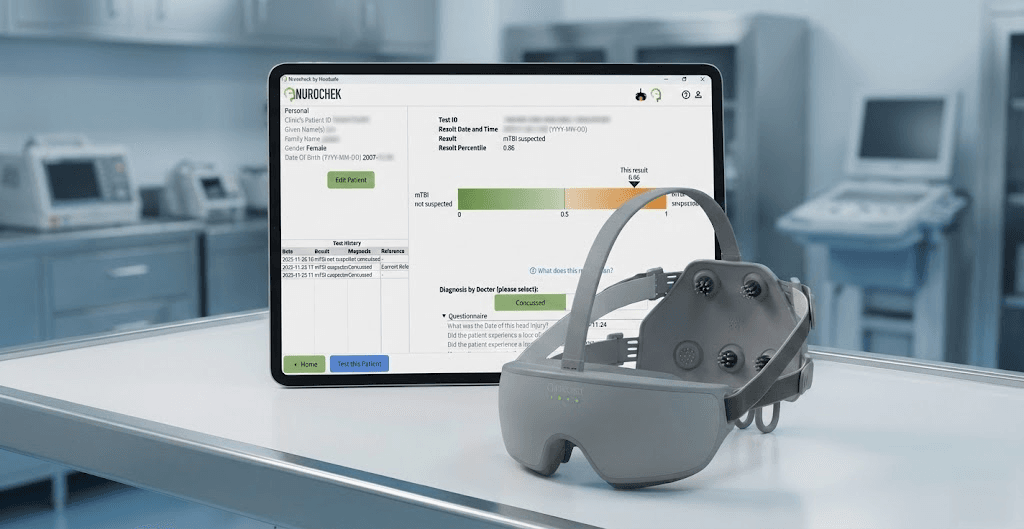
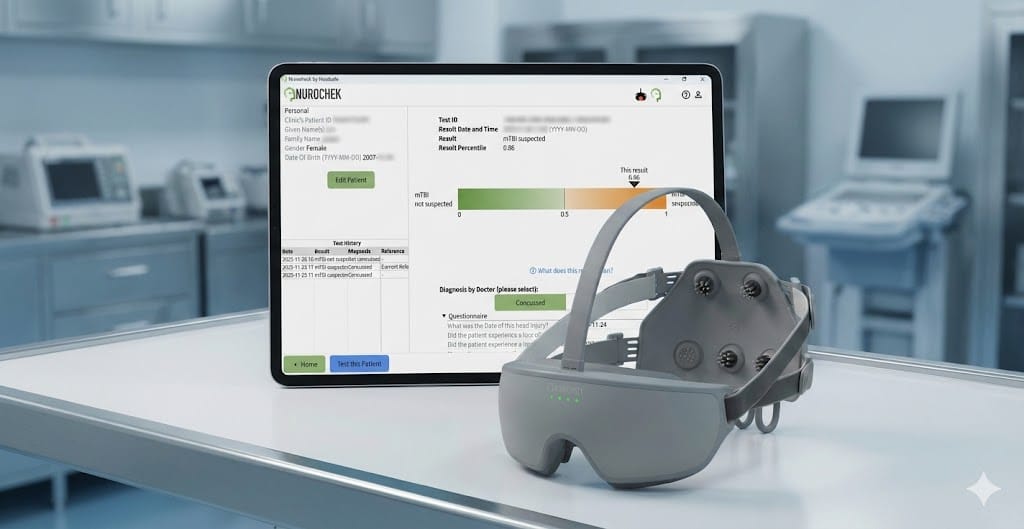
CC: Nurochek is a portable, FDA-cleared brain scanner that provides an objective assessment of brain function as an aid to the diagnosis of concussion. It uses electroencephalography, known as EEG, and visual evoked potentials – VEP – to measure how the brain responds to controlled visual stimuli. The test takes about two minutes.
The clinician or trained staff member fits a lightweight headset, starts a guided software protocol, and Nurochek records brain activity while the patient looks at simple light patterns. Built-in algorithms via AI and machine learning analyze the signal and produce a clear report that supports the clinician’s decision-making.
Let’s be clear: Nurochek does not replace CT or MRI when there is concern about bleeding or structural damage, nor does it replace clinical judgment. However, it adds an objective brain signal response to the existing assessment, as a result decisions are based on more than symptoms, memory and eye tests.
Concussion as a silent epidemic
GV: I was looking at your brochure, and concussion is described as a silent epidemic. What does that mean in practice?
CC: It simply means that the number of concussions is mind-boggling, and many injuries are missed. You do not always see a dramatic knockout. People continue to play, drive, or work, and they underreport their symptoms. Diagnosis still relies heavily on checklists and questions that are easy to influence. The CDC has determined that around the world, 50% of concussions go undetected.
Global estimates suggest tens of millions of concussions each year, and a large share as I stated are either undetected or not documented. Behind every missed diagnosis is a person who may be at risk of a second impact, prolonged symptoms, or long-term effects. Objective testing will not solve every case, but it gives us a better chance to identify those who need help.
Speaking to urgent care leaders, sports medicine teams and neurology clinics
GV: Let us focus on one audience. Imagine you are talking directly to a medical director running a busy emergency department or urgent care network. What is your message?
CC: I would say this. Your job is to protect patients while managing flow and resources. You want to avoid unnecessary scans, but you never want to miss a serious brain injury. You also need tools that fit your workflow, not slow it down.
Nurochek gives you a two-minute, baseline-free assessment that trained nurses or technicians can perform. The report adds objective brain data to your decision about whether to scan, observe, or discharge. There is a path to bill the procedure under existing visual evoked potential and EEG CPT codes, subject to normal payer policies, so it can fit into a sustainable service line.
GV: Now picture an athletic director or head athletic trainer who worries about athlete safety and reputational risk. How do you talk to them?
CC: They carry a lot of responsibility. Every season, they face questions from parents, boards, and media about how they handle head injuries. They already use protocols, but many of those tools are subjective.
Nurochek brings objective data to that environment. In about two minutes, they can see how an athlete’s brain is responding. When the signal looks abnormal, they can hold the athlete out with confidence and document the decision. It shows they take safety seriously and use the best available tools to protect their athletes.
GV: How about neurology and concussion clinics that follow patients for months rather than minutes?
CC: Those clinicians want credible, repeatable measurements. Patients ask, “How do you know I am ready to go back to school, work, or sport?” It is a fair question.
For them, Nurochek offers a standardized assessment of brain function that can be repeated over time. Results are stored securely, so they can track recovery trajectories. Many clinics can bill using existing codes, again subject to payer rules, which helps integrate Nurochek into a viable care model. The technology is supported by multi-site research in Australia, New Zealand, and the United States, which gives specialists confidence in the science behind it.
GV: Beyond hospitals and sports programs, you are also talking to imaging centers and MSK clinics. What role can Nurochek play for them?
CC: Imaging centers often compete on price and speed. Nurochek lets them add a functional brain assessment that complements CT and MRI, especially in mild traumatic brain injury, where scans may be normal. It can help them stand out to referring physicians who want more than a “normal CT” when symptoms persist.
Innovative practices, including some chiropractic and rehab groups, are seeking objective measures to support their care plans. Nurochek gives them an FDA-cleared, brain-based assessment that strengthens their conversations with patients, payers, and referring doctors.
Evidence, AI, and research partners
GV: Some readers are academic neurologists and concussion researchers. What should they know?
CC: First, Nurochek is built on years of research and collaboration with leading universities. The algorithms were trained on data from multiple sites and refined with input from neuroscientists and clinicians. Second, the system is well-suited to clinical studies. It can be deployed at the point of care, it produces structured data, and it can support questions about prognosis, recovery, and response to treatment. Third, we are open to research partnerships that advance the field, particularly related to sensitivity and specificity. The goal is not only to sell devices, it is to help define a new standard for objective concussion assessment.
CEO priorities for the next phase
GV: Looking ahead over the next 18 months, where will you focus as CEO?
CC: I have three main priorities.
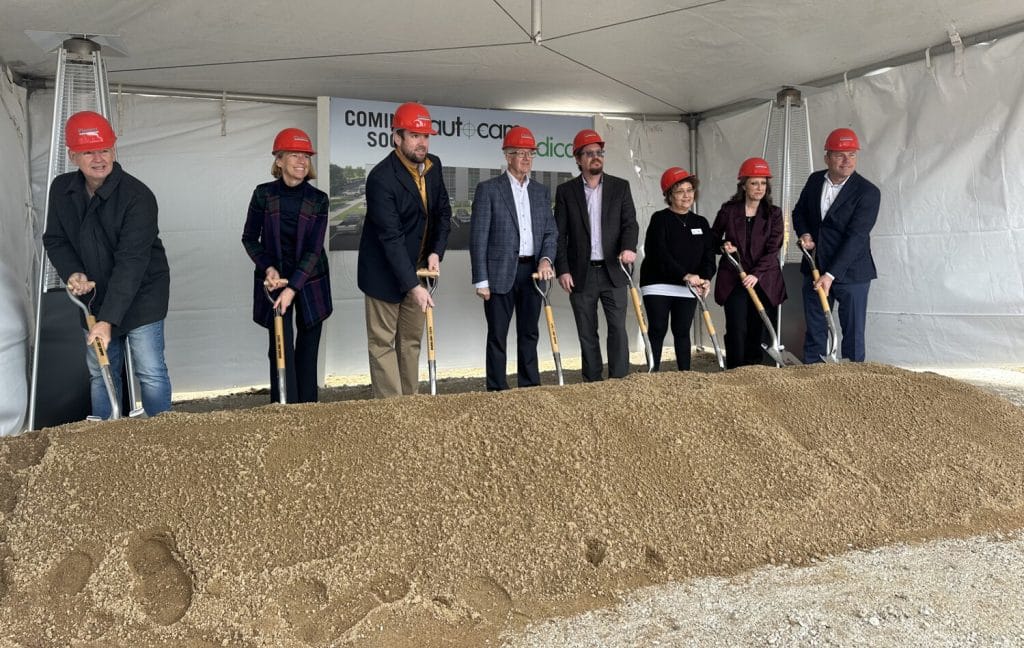
The first is the successful onboarding of early adopter US sites. That means training, workflow integration, technical support, and collecting feedback so Nurochek becomes part of daily practice.
The second is building the evidence and reimbursement story. We will continue clinical studies and health economic work that demonstrate both patient benefit and system value.
The third is thoughtful geographic expansion. We will focus on centers that are serious about concussion care and can act as reference sites in their regions, rather than trying to reach every market at once.
GV: This is quite an ambitious plan. Congratulations! Now, as you know, many MedTech founders follow the “Experts in Motion” series. What advice would you offer them?
CC: Be very clear about the problem you solve and the value you create for each stakeholder. The ER doctor, the athletic trainer, the neurologist, the administrator, the payer, and the investor all have different priorities. You must respect each one.
Also, do not race ahead of your evidence. Early sales feel exciting, but long-term success comes from strong data, clean regulatory positioning, and products that genuinely improve care.
GV: Great advice. So, that leads us to our final question. Where do you see Headsafe and Nurochek in five or ten years, and how would you like this chapter to be remembered?
CC: In 5 years, I would like Nurochek to be part of standard concussion pathways in leading emergency departments, sports programs, and specialty clinics in the United States, Australia, New Zealand, and other key markets.
In 10 years, I hope objective brain assessment will feel as natural in concussion care as measuring blood pressure feels in cardiovascular care. When someone presents with a suspected concussion, running a quick, objective brain test should be the norm.
Personally, I would like to be remembered as someone who helped good science reach the people who need it, and as a leader who treated teams, partners, and investors fairly. If thousands of clinicians can say, “I made a safer decision because I had Nurochek in my toolkit,” that will be a legacy worth having.
Thank you, Craig, for such an open and energizing conversation. It is obvious that the concussion world truly needs the kind of objective brain data that Headsafe is bringing to the front line of care, and I am excited to see where you take it next.
To our readers, if you would like to explore how Nurochek could fit into your ER, concussion clinic, imaging center, or athletic program, please visit headsafe.com or reach out directly to Craig and the Headsafe team for more information.