
Karl Neuberger on the Work That Makes, or Breaks, a Device Market Launch
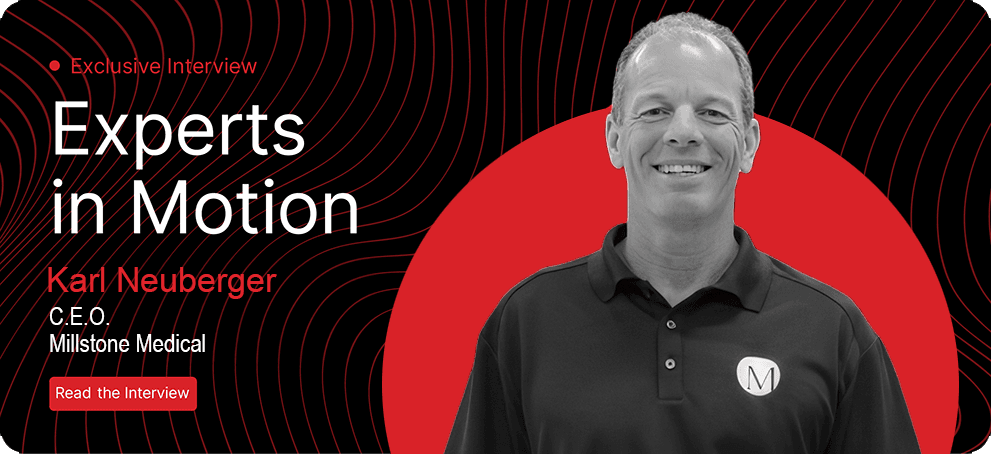
Millstone CEO Karl Neuberger on the readiness work OEM teams cannot afford to treat as an afterthought, and why “one PO” changes how complex programs perform.
An Interview with Karl Neuberger
Chief Executive Officer, Millstone Medical Outsourcing
By Guillaume Viallaneix | Editor-in-Chief, The MedTech Digest and President, MedTech Momentum

I have spent enough time with MedTech leaders to know the work that protects a launch is rarely the work that gets celebrated.
The spotlight goes to design wins and clinical milestones. The outcome gets decided later, in the readiness work: supplier coordination, sterile packaging and labeling control, testing strategy, documentation integrity, and release discipline.
Karl Neuberger leads in that zone. He joined Millstone Medical Outsourcing in 2011, stepped into the CEO role in 2017, and has navigated a market where expectations keep rising. Launch windows keep tightening. Compliance demands keep growing. Device ecosystems keep getting more complex.
This conversation matters because more teams are learning a simple truth. A device is not “done” when it is built. It is done when it is ready for release, ready for the patient use, and ready for real-world variability. That readiness stage is becoming the battleground for speed, quality, and trust.

Guillaume: Karl, take us back. Where did your journey begin, before MedTech, before Millstone?
Karl: I started in sales and marketing. It was formative because you learn early that value is not what you say, it is what the customer experiences. You also learn to listen. If you pay attention long enough, the market tells you what is broken.
Guillaume: You have a Dartmouth background and an MBA from Tuck. Did that shape how you lead today?
Karl: It did, not because of any single class, but because you are trained to think across functions. Operations, finance, customer needs, talent. In my world, leadership is integration. You have to see how the pieces affect each other, then build systems that hold under pressure.
Guillaume: You joined Millstone in 2011 to run operations for the Memphis-area facility. Why that move?
Karl: Millstone was growing, and it was practical growth. We were close to the customer, close to the work, close to the constraints. I liked that. It was not theoretical. It was this: can you execute with quality under real pressure?
Guillaume: You became CEO in September 2017. What did you feel you needed to protect as you took the top job?
Karl: The standard. When you scale in MedTech, the temptation is to treat quality like a department. Quality is a culture and a system. If you do not protect it, growth punishes you.
“Ready” is where programs win, or fail
Guillaume: Millstone sits in a category many people still struggle to describe. For readers who do not know your world, what do you do in plain English?
Karl: We help OEMs take complex programs from components and forecasts to finished sterile devices, reliably, at scale, with one accountable program team. That includes supplier coordination, product-specific cleanroom assembly, sterile packaging and labeling, testing support, documentation, and logistics through shipment.
Guillaume: What is the real problem you are solving?
Karl: The cost of handoffs. Programs do not fail because people are not trying. They fail between steps when accountability is unclear, documentation does not travel cleanly, or timelines get squeezed and everyone optimizes their own slice.
Guillaume: Let’s make that real. Tell me a story where a small detail, packaging, a set turnaround, a validation step, had a big impact.
Karl: Sterile packaging is a great example. Most people see a sealed pouch and assume it is simple. Behind that pouch is a chain of decisions: materials, sealing parameters, shelf-life assumptions, labeling accuracy, and validation. If any part is weak, you create rework and you introduce risk.
In the field, time matters. If a surgical team needs a specific configuration and it is not ready, clean, complete, and correctly documented, you do not only miss a shipment. You trigger urgent resupply, case planning disruption, and escalation across the OEM team.
Guillaume: That is a big statement.
Karl: It is true. In our world, “ready” carries consequences. The work has to be disciplined because the downstream impact is real.
Guillaume: That patient connection is unusual for a B2B services company. How do you keep it alive when the work is demanding and repetitive?
Karl: You do not turn it into a slogan. You connect it to decisions. If a shortcut adds risk, you name the risk plainly. If a team catches a labeling issue before it leaves the building, you celebrate it as patient protection. People want purpose, but they want it grounded. In our business, purpose shows up as discipline.
Why “one PO” is the point
Guillaume: Millstone’s repositioning for 2026 is clear: certainty for device complexity. What does that mean to you?
Karl: It means the program holds, especially on the bad day. It means OEM teams can plan around reality instead of living in escalation mode. It means fewer handoffs, clearer ownership, and stable processes that do not depend on heroics.
Pull quote: Certainty means the program holds, especially on the bad day.
Guillaume: Give it to us in one sentence.
Karl: We want to be the partner OEMs trust to manage their most complex programs under one PO, so they can increase speed to market, reduce risk, and protect brand reputation.
Guillaume: Under one PO is a strong claim. What changes for the customer when that is true?
Karl: Accountability becomes real. Instead of coordinating five vendors and reconciling five versions of the truth, you have one program team responsible for the outcome. We coordinate suppliers. We run assembly and packaging. We support testing and documentation. We manage logistics. We are measured on whether the program performs.
Testing, capacity, and the investments behind certainty
Guillaume: Under your tenure, Millstone moved deeper into testing. What was the why?
Karl: Customers want fewer handoffs. They want speed, and they want speed they can defend in an audit. Testing sits on the critical path. When turnaround improves and service is consistent, uncertainty drops across the entire program.
Guillaume: You also invested in expanded capacity. Why make those bets?
Karl: Because demand does not wait for you to feel ready. If you see a bottleneck forming, capacity, turnaround, coordination, you invest before it becomes the customer’s problem. In MedTech, time is not neutral. Time can be risk.
Pull quote: In MedTech, time is not neutral. Time can be risk.
Regulation, complexity, and the cost of ambiguity
Guillaume: EU MDR and broader compliance pressure keep raising the bar for what “ready” means. What do leaders underestimate?
Karl: How much it shifts the downstream workload. It is not only documentation. It is packaging conversions, validations, labeling controls, traceability, and testing requirements. If you do not plan for it early, it shows up as missed timelines and rushed decisions, and that is when mistakes happen.
Guillaume: Outsourcing used to be framed as cost. Now it feels like a performance decision. What changed?
Karl: Complexity changed. Expectations changed. The cost of getting it wrong changed. OEMs are balancing speed to market, quality, and resilience. The right partner helps you control outcomes.
Guillaume: What is the biggest hidden complexity in MedTech right now?
Karl: The interfaces. Everyone is good at their step. Programs break at the handoffs, when ownership is unclear, when suppliers drift, when labeling and packaging controls are out of sync with the schedule.
What investors and customers actually look for
Guillaume: Investor lens for a moment. What do strong investors see in this segment?
Karl: Durable demand and rising complexity. They also look for proof. Can you scale without quality drifting? Can you expand without losing focus? That is where operational discipline matters.
Guillaume: And from the customer’s point of view, how do you prove you are delivering?
Karl: Outcomes. Fewer escalations. Cleaner documentation. Audit readiness. Faster, more predictable release. Less internal burden for the OEM team. If the customer still has to quarterback everything, you are not removing complexity. You are standing nearby.
Guillaume: I lead MedTech Momentum, so I have to ask a marketing question in a practical way. In your world, the work can feel invisible. How do you communicate invisible work so customers actually feel the value?
Karl: Use outcomes, not adjectives. Explain what the model removes: handoffs, ambiguity, late-stage surprises. Be clear that the program is owned end-to-end. Then share one scenario the customer recognizes, the program stayed on track because the system held.
If your message cannot be repeated simply by a VP of Ops, a Quality leader, and a Launch Manager, it is not a message yet.
Guillaume: That is exactly the trap I see: brilliant operations, unclear story. The market rewards clarity. Clarity comes from choosing what you want to be known for, and saying it consistently.
Advice for founders, clinicians, and procurement leaders
Guillaume: For founders entering MedTech, what should they operationalize early to avoid paying for it later?
Karl: Build the quality system early. Build traceability early. Take packaging, labeling controls, and test strategy seriously from the start. If you treat readiness as “later,” later becomes urgent.
Guillaume: For clinicians and procurement leaders, what is the one question you wish more people asked before adopting a device program?
Karl: “What happens on a bad day?” How do you handle variability, urgent demand, returns, missing components, and a tight window? The best systems are defined by how they behave under stress.
Pull quote: The best systems are defined by how they behave under stress.
Guillaume: Final question, vision and legacy. Where do you see Millstone in five years? In ten? And how would you like to be remembered?
Karl: In 2026 and beyond, our direction is clear. We want to be the partner OEMs trust to manage their most complex programs under one PO, so they can move life-changing devices to patients faster, with less risk and less internal burden.
In practical terms, that means doubling down on what certainty for device complexity requires: program and supply chain ownership, product-specific cleanroom assembly, and the integrated work that determines whether a program holds, sterile packaging and labeling, testing, and logistics, through shipment of finished sterile devices.
If we do it right, OEM teams get outcomes they can feel: faster and more predictable launches, cleaner documentation and audit readiness, fewer escalations, and stronger supply continuity, with a partner who is accountable end to end, not just for one step.
Personally, I would like to be remembered for protecting quality, sterile integrity, and brand reputation while building a model that delivers speed and stability, because in MedTech, that is what certainty really means.
Karl’s story is a reminder that the work most teams never see is often the work that decides the outcome.
As device complexity rises and timelines compress, leaders will win by building systems that deliver speed you can defend, quality you can audit, and partnerships you can rely on.
To learn more about Millstone Medical Outsourcing, follow company updates and connect with the team through official channels.