








Nanovis Built Implants to Prove Its Nanotechnology. Now the Technology Is the Business.
EXPERTS IN MOTION · INTERVIEWS
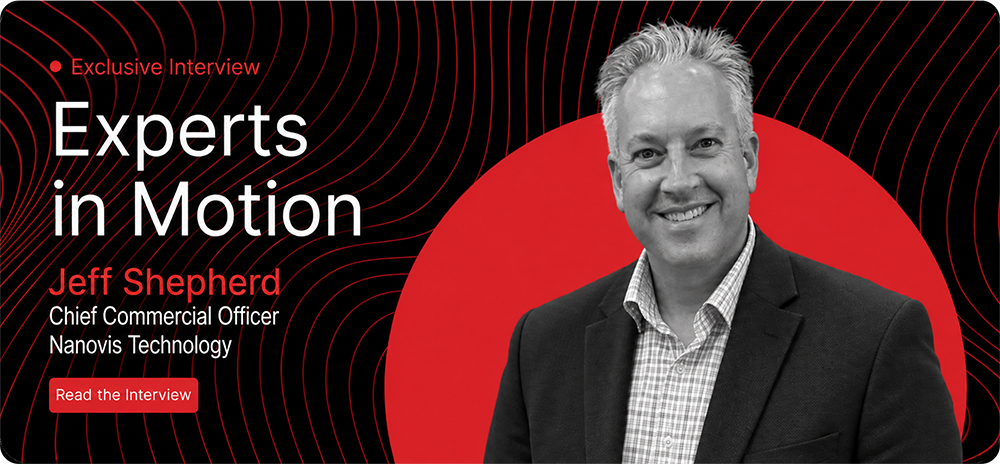
Jeff Shepherd, Chief Commercial Officer, on licensing Nanovis nanotechnology to Medtronic for spinal interbodies, unwinding the spine hardware business, and what medical device OEMs get from a nanotechnology partner.
An Interview with Jeff Shepherd, Chief Commercial Officer, Nanovis
By Guillaume Viallaneix | Editor-in-Chief, The MedTech Digest & President, MedTech Momentum
October 2026 · A twelve minute read
I have known Jeff Shepherd for the better part of a decade. MedTech Momentum is the marketing partner of Nanovis, so I am not a neutral observer here. What I can tell you is that the Jeff you meet in a boardroom is the same Jeff you meet over lunch.
His values were set early. He grew up in Carmel, Indiana, in a basketball family, with a mother who taught children with special needs. Every career move since has followed one question he shared with me on our call: who are the good people doing good things, and how do I align with them?
At Nanovis he found a company that asks the same question about its customers. When Medtronic licensed its nanotechnology for spinal interbodies, Nanovis unwound its own spine hardware business and put its deep science, manufacturing, regulatory, and commercial experience to work for other OEMs. Today Nanovis is a technology company, and its product is the surface on other companies’ implants. Jeff says it plainly: their success matters more than ours. That is how Nanovis is building its place in medical devices, one OEM relationship at a time, with each one earning the next. When I spoke with Nanovis CEO Brian More in May 2025, he described the start of this shift. Jeff picks up the story from the commercial side. Thank you, Jeff, for the time and the candor.
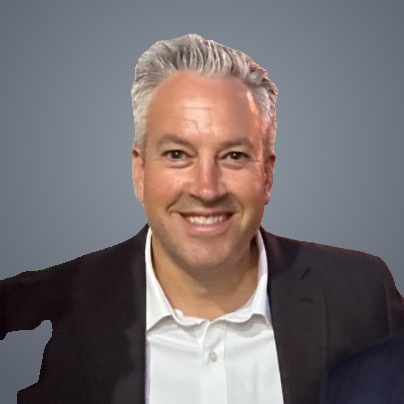
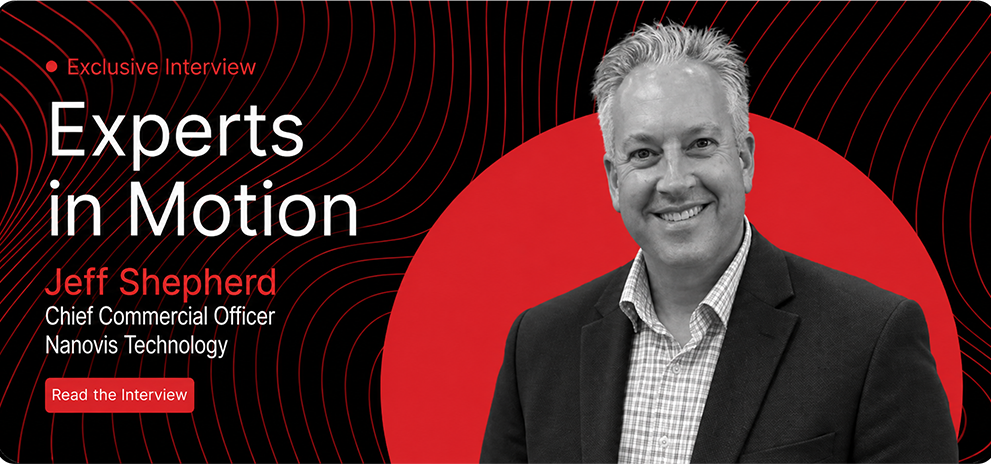
Jeff Shepherd
Chief Commercial Officer, Nanovis
Jeff joined Nanovis in 2014 to build its commercial organization. Before that he spent nearly a decade at Codman Neurosurgery, a Johnson & Johnson company, rising from sales rep to regional sales director over a business of more than $100 million. He was a three time All-American basketball player at Huntington University.
From Carmel to Johnson & Johnson
By the numbers
2006
Founded on nanotechnology IP licensed from the Purdue Research Foundation
50,000+
Devices implanted with Nanovis surface technology, as of September 2026
10+
Products cleared with an FDA nanotechnology designation, as of September 2026
1st
Company to earn FDA nanotechnology designation for a pedicle screw system
Sources: Nanovis (device and product counts) · nanovistechnology.com (About; Surface Technology)
Guillaume: Take us back to the beginning. Where did it start?
Jeff: I was born in 1976 and raised in Carmel, Indiana, just north of Indianapolis. Basketball was a big part of our family. My dad, Billy Shepherd, was Indiana Mr. Basketball in 1968, and my uncle Dave was Mr. Basketball in 1970. My dad went on to play in the ABA with Dr. J and was coached by Wilt Chamberlain. But just as influential to me was my mom, who taught kids with special needs. From both sides, I learned early about competing, serving and caring for people.
I played basketball at Huntington University, graduated in 1999, and was a three time All-American. Sports taught me a lot about preparation, resilience and being part of something bigger than yourself. When I look back at my career, though, the common thread has really been people. I have always tried to ask: Who are the good people doing good things, and how can I align myself with them? That has guided a lot of the biggest decisions I have made.
Guillaume: You did not start in MedTech, though.
Jeff: No. From 1999 to 2004 I sold laser cutting machines, punch presses and press brakes in the metal fabricating industry. It was straight commission. You eat what you kill. That experience taught me how to compete, how to listen to customers and how to earn business. I am grateful for it, but I also knew I wanted my work to mean more.
Then a former teammate who was in medical devices took me to lunch and said, "Jeff, you have got to get into medical device. I get to wake up every day and help patients." That hit me. It gave the work a much bigger why. From 2004 to 2014 I was with Codman Neurosurgery, a Johnson & Johnson company. I was rep of the year in 2004, runner up rep of the year in 2005, and by the end I was leading a region of managers and reps with over $100 million in cranial neurosurgery product revenue. I loved the culture, the people, the competition and the business, but most of all I loved knowing the work we did ultimately mattered to hospital administration, clinicians, and patients.
Choosing the Startup
Guillaume: So why leave J&J for a company with no cleared products?
Jeff: A reorganization at the end of 2013 came with the option of moving my family of six to Massachusetts, and we really wanted to stay in Indiana. Around that time, I served on a university board with Brian Emerick, who founded Nanovis. He introduced me to Matt Hedrick, then CEO, and Brian More, then our fractional CFO and now our CEO. The more I learned about the people and the technology, the more interested I became.
A friend who led that board boldly shared that he was praying that two opportunities would come in at the same time so I would have a choice, and that God would make clear what choice was the right choice. In April 2014, that is exactly what happened: on the same day, I received two offers, one from Nanovis and one from a large OEM. My wife and I prayed about it throughout the interview process and felt led to Nanovis. It was great people, close to home, meaningful technology and a chance to build something. We felt that if we were ever going to take that kind of risk, this was the time. Looking back, it was one of the most important decisions of my career.
Guillaume: What was the job when you walked in?
Jeff: Build a spine business, essentially from the ground up. The science was fascinating, but we also understood something important: an OEM is unlikely to adopt a technology that nobody has taken all the way through manufacturing, regulatory, and real clinical use. Somebody had to prove it end to end, and we decided that somebody would be us. Spine was a great place to do it because surface technology could matter both clinically and commercially. We earned our first product clearance in 2015 with cervical interbodies, then TLIF, and PLIF followed. Later we became the second company in the world to earn an FDA nanotechnology designation on an interbody fusion cage, and in 2021 the first on a pedicle screw system. We were not just talking about what nanotechnology could do. We were proving that it could become a real business.
Becoming a Technology Company
Guillaume: Then Medtronic came in. How did that change the company?
Jeff: It clarified who we were. Competing head to head with the largest spine companies would have required enormous investment, and that was never where the greatest value of Nanovis lived. The real value was always in our technology, our science, and our ability to translate that technology into cleared, manufacturable products. We built the spine implant business because we needed to prove all of that ourselves.
When Medtronic licensed our nano surface technology for Ti/PEEK interbody devices, it validated that strategy in a meaningful way. We knew the next chapter was not about trying to become another spine hardware company. It was about becoming the surface technology partner for OEMs. From that point forward, our job became very clear: understand the problem a partner is trying to solve on an implant, link arms with their team and help them find the right surface solution. Their implant. Their brand. Their success, powered by technology we know extremely well.
“Their implant. Their brand. Their success, powered by technology we know extremely well.”
Guillaume: What does an OEM actually get when it works with you?
Jeff: I think about it in three parts. First is deep science expertise. We have an experienced team who works directly with an OEM’s engineers and R&D leaders, backed by a substantial body of data. We want to be more than a surface technology vendor. We want to be the surface technology experts sitting beside their team and helping solve real problems.
Second, we work hard to make adoption easy. We are vertically integrated: we develop the surface and produce it in house, using a specialized anodization process we control from start to finish. For the OEM, that can mean one partner, one PO and a team that understands the technology all the way from feasibility through production. Removing friction matters. Great technology only creates value if a customer can actually implement it.
Third is proof. We have taken nanotechnology through development, FDA clearance, scale up and commercialization. The Medtronic relationship pushed us to scale and strengthened the discipline of our quality system. So, whether we are working with a large strategic OEM or an emerging company, we bring more than an idea. We bring experience. That gives our partners confidence that there is a path from an exciting surface concept to a product they can actually launch.
How an OEM Project Actually Works
Guillaume: Walk me through a real project. You do not have to name the customer.
Jeff: Take screws as an example. They are everywhere in medical devices: spine, foot and ankle, total joints, upper extremity, trauma, rib fixation, CMF, dental and more. When you step back and look at how many implants depend on fixation to bone, the opportunity is enormous. That is where we believe our nanotechnology can create real value for the implant, for the OEM and ultimately for the patient. An engineering leader may immediately ask, "What does your surface do to the mechanical performance of my implant?" That is exactly the kind of question we want. We have already done a significant amount of feasibility and characterization work, much of which is captured in our master file and can support the OEM’s development process. We try to answer the hard questions early so their team can move forward with confidence.
Then we stay shoulder to shoulder with them through verification and validation and into the regulatory filing. For 510(k) projects, we can support the regulatory story, including the labeling and nanotechnology designation strategy. By launch, this is no longer just an engineering project. The commercial team has a differentiated story it can take to surgeons and hospitals to gain market share and access. The best sign that we have done our job well is when a partner launches and then comes back and says, "Here is our next project." That is the kind of relationship we want to build.
Guillaume: How much of the value is commercial rather than technical?
Jeff: It’s a good balance. The technology has to earn its way clinically and technically first. There are no shortcuts there. But ultimately an OEM also has to win in the market. Differentiation matters. A strong regulatory label can give the commercial team something specific and credible to talk about. With nanotechnology, the surface is intentionally engineered at the nanoscale to drive a biologic response, and achieving an FDA nanotechnology designation requires real work and supporting evidence.
That can give a rep a meaningful story to bring to a surgeon, a hospital and a value analysis committee. It is not just another feature. It is a technology with a defined regulatory and scientific foundation. In my experience, some hospitals also create pathways that recognize meaningful innovation in purchasing or pricing discussions. That is why we want marketing and commercial leaders involved early, alongside engineering and regulatory. If we understand from the beginning how the technology needs to create value, we can help build a better program around it.
The Hard Part: Creating a Market
Guillaume: What has been the toughest challenge in this new model?
Jeff: We are helping create a market, and that is both the challenge and the opportunity. Spine companies understand the nano story because the category has already seen meaningful adoption and success. In areas outside of spine, the conversation is still early, which creates an exciting opportunity for OEMs to innovate and differentiate. So, our first job is to earn the opportunity: find the right product, with the right partner, where they are willing to give us a shot. Then we have to deliver. Every successful project builds trust and opens the door to the next one. Our goal is simple: when a medical device company starts thinking about how a surface can improve or differentiate an implant, we want Nanovis to be the first call they make.
Guillaume: Where does 3D printing fit?
Jeff: Hand in glove. Additive manufacturing gives you this incredible macro porous architecture, and our process can complement that architecture at a completely different scale. Because it is an aqueous process, the nano surface can get in, on, and through the porous and lattice structures. I describe it as a surface on a surface: the macro and micro architecture created through additive manufacturing for osseointegration, enhanced with a nanotechnology surface to drive early biologic healing and increase and accelerate mineralization of stem cells and osteoblasts. To me, that combination is one of the exciting opportunities ahead for implant design.
“We want Nanovis to be the first call they make.”
What Comes Next
Guillaume: What is next for Nanovis?
Jeff: Continued adoption. But I think the bigger vision is becoming the surface technology partner medical device OEMs trust across their portfolios. We already have several OEM projects underway, and we are continuing to build a broader portfolio of surface technologies, so the answer is not always, "Here is the one surface we sell." It is, "Tell us what you are trying to accomplish, and let us help identify the right surface for that implant." In some cases, you may want stronger integration; in others, you may intentionally want something different. We have the capacity to scale, the experience to support OEM programs and a team that is hungry to help. Right now, we are focused on finding great partners, solving meaningful problems and earning the next project.
Guillaume: Last question. How do you want to be remembered?
Jeff: My Christian faith is the foundation of who I am, and I hope that comes through in the way I care for and treat people, both personally and professionally. At the end of the day, I want people to know that I genuinely cared about them, not just about what we could accomplish together.
I’ve learned that the real reward in business is the relationship. And meaningful relationships aren’t built through a transaction or a single meeting. They’re built over time, through shared experiences and especially through those moments when trust is required. It’s how you show up for people when things are going well, but maybe even more importantly, how you show up when they aren’t.
That is how I want us to operate at Nanovis. I want our customers to know that we care deeply about their success and that they can trust us to do our very best for them. Their success really does matter more than ours, because if they aren’t successful, neither are we.
“Their success really does matter more than ours, because if they aren’t successful, neither are we.”
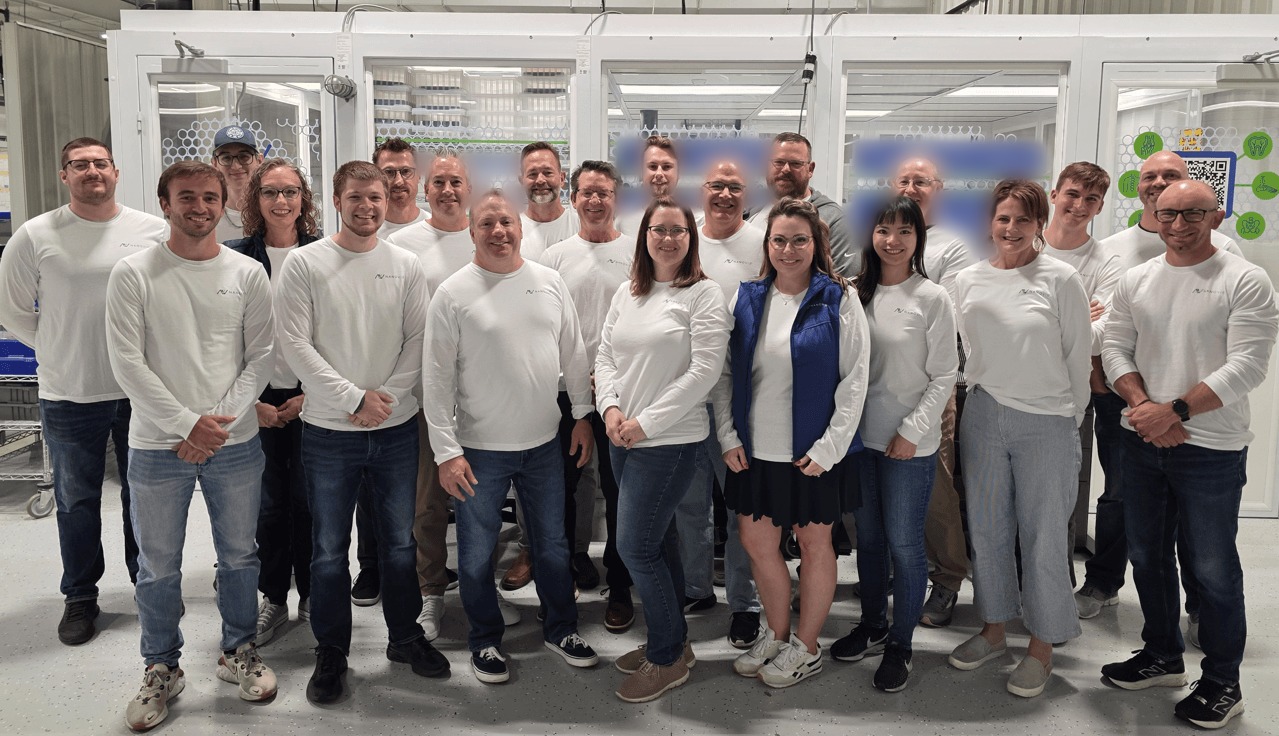
I told Jeff at the end of our call that Nanovis is a people company. In an industry where the human side often hides behind the business, with Jeff it never does.
If you lead engineering, R&D, or marketing at a medical device OEM and a surface technology question is on your list, Jeff is easy to reach. Email him at jshepherd@nanovistechnology.com, connect with him on LinkedIn, or learn more about Nanovis at nanovistechnology.com.
This interview is part of Experts in Motion, an exclusive series from The MedTech Digest featuring the leaders shaping tomorrow’s healthcare technology.
Working on an implant and weighing a surface technology? Start the conversation with Jeff Shepherd directly.